
Peoria Projected Versus Actual Release
A projected release date is a current calculation. An actual release date records what happened after all valid credits, orders, holds, and agency steps were resolved. For an IDOC case, the Parole Date often marks movement from prison into community supervision. Projected Discharge Date is the expected end of IDOC legal control. Those fields describe different events.
A pretrial detainee in Peoria County Jail usually has no sentence-based date to calculate. A judge's release order may still be subject to another hold, and physical departure can occur after the order is entered. The county jailing record supplies the discharge or transfer time.
Find Peoria County Release Dates
Use the source tied to the custody. Illinois credit rules do not set the departure date for a person awaiting trial, and Peoria jail records cannot calculate a federal term.
- Find the Peoria County court case and read the judgment or current custody order.
- Decide whether the person is in county, IDOC, or federal custody.
- For IDOC, use the Individual in Custody Search and match the IDOC number.
- Record Offender Status, Location, Parole Date, Projected Discharge Date, and whether the sentence is discharged.
- Recheck after a credit award, discipline event, amended judgment, appeal, or board action.
- After the date, confirm the actual result through the releasing or receiving agency.
For a local sentence, compare the Peoria Circuit Clerk order with the Sheriff's jailing record. If the public view is unclear, request the booked, discharged, or transferred date and time. A transfer to IDOC closes county custody but does not return the person to the community.
Illinois Credits Shape Peoria Releases
730 ILCS 5/3-6-3 controls key sentence-credit rules. Illinois has no single “85 percent law” for every conviction. Depending on the offense and date, a person may receive a day-for-day baseline, may be limited to about 85 or 75 percent served, or may have to serve 100 percent. Match the exact subsection to the conviction and offense date.
Earned Discretionary Sentence Credit is governed by 20 Ill. Admin. Code 107.210. Eligibility does not ensure an award. Statutory floors still apply, and discipline can lead to credit loss. A qualifying sentencing admonition uses “at least” 85 percent, so rough arithmetic should not be presented as an exact day.
The official statute capture gives the source context for those percentage limits.
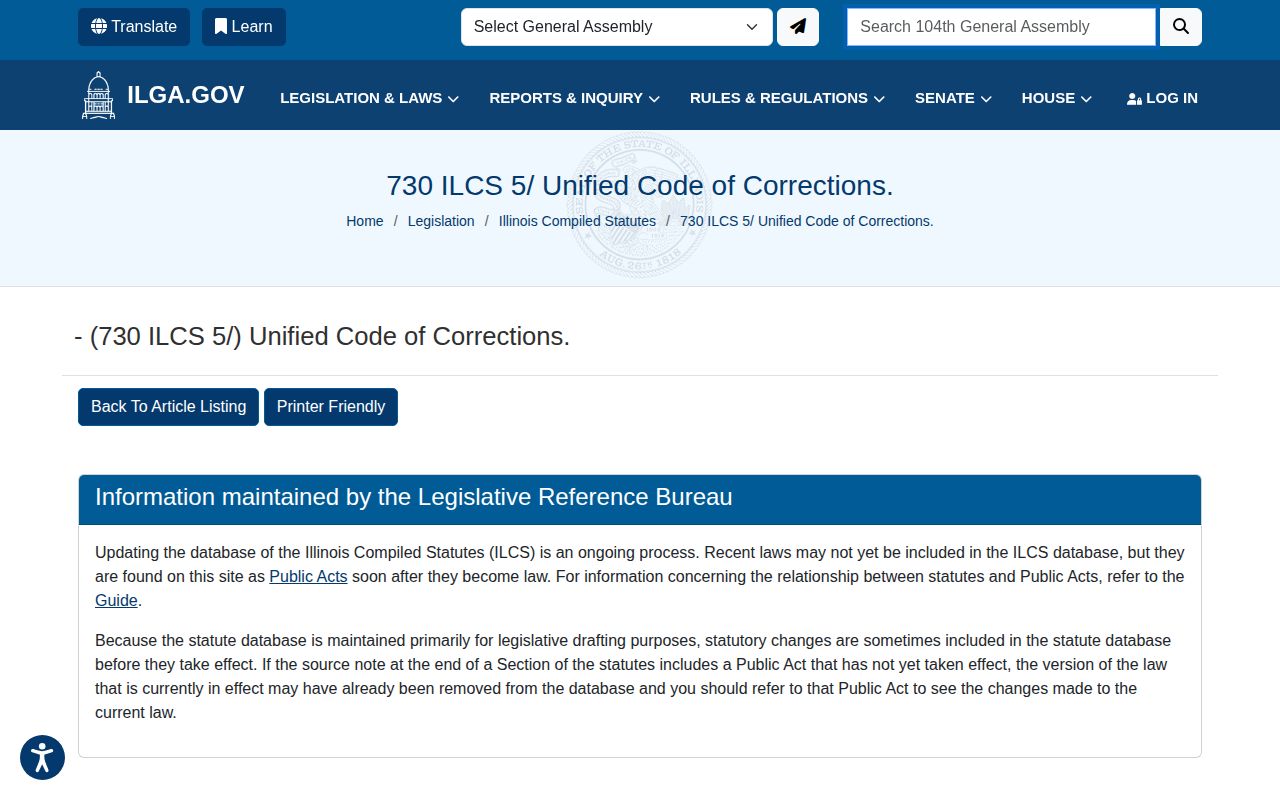
Apply the law to the entered judgment and official IDOC calculation, not to the charge name alone.
What Changes Peoria Release Dates
Sentence computation is not simple subtraction. The offense date, conviction statute, concurrent or consecutive terms, presentence custody credit, and later legal events can all affect the calculation.
| Factor | Possible effect | Record |
|---|---|---|
| Earned credit | May move a date earlier within legal limits | IDOC profile |
| Credit loss or restoration | May move the date later or earlier | IDOC calculation |
| Corrected judgment | Changes the sentence basis | Court docket |
| Concurrent or consecutive terms | Changes how terms combine | Judgment |
| Detainer | May lead to transfer, not community release | Transfer record |
| Board action | May change custody or supervision | PRB and IDOC |
A detainer is a request or legal basis for another authority to take or hold the person. It can mean departure from one facility is a transfer. The record should name the receiving system when public.
Verify Peoria Release Outcomes
Once a date passes, check whether IDOC shows parole, continued prison custody, Adult Transition Center placement, transfer, or final discharge. A person at the Peoria Adult Transition Center remains in state custody even when approved to work or study outside. Read Location and Offender Status together.
Illinois VINE can report a custody event, but it is not the archival calculation record. The VINE Inmate Check may provide notice, while the court, IDOC, or jail record confirms the outcome. The Peoria County released inmate lookup maps the county record path.
Peoria County Jail Date Limits
Pretrial release depends on current court orders, not a good-time formula. A sentenced local detainee may have a term and custody credit, but another warrant, detainer, or transfer order can change the outcome. Read the free Circuit Clerk docket for legal authority, then use the jailing record for actual movement.
Ask the Sheriff's record route for the date and time received, discharged, or transferred, plus disposition and receiving agency if recorded. Illinois FOIA section 2.15 supports those custody-movement fields, subject to exceptions. No verified Peoria rule promises an early Friday release when a date falls on a weekend.
The Circuit Clerk order can explain why custody should end, but it may not state the minute the jail completed processing. A release order can also be followed by another hold. For that reason, court authority and jail movement should be read as two parts of one event. If the county record says transfer, continue in the receiving system instead of describing the person as released to the community.
A Peoria County records request should identify the person, booking number or date range, and case number when known. Ask for both discharge and transfer data. That wording avoids the common mistake of requesting only “release,” which may miss a handoff to IDOC, another county, federal custody, or another lawful custodian.
Peoria Release Credit Recalculations
IDOC says an Earned Sentence Credit change appears in the public profile. Its Victim Services material warns that qualifying statutory recalculation can significantly advance dates. A saved profile image is a dated observation, not proof of the current calculation.
The IDOC sentence-credit explanation shows how credit updates reach the profile.
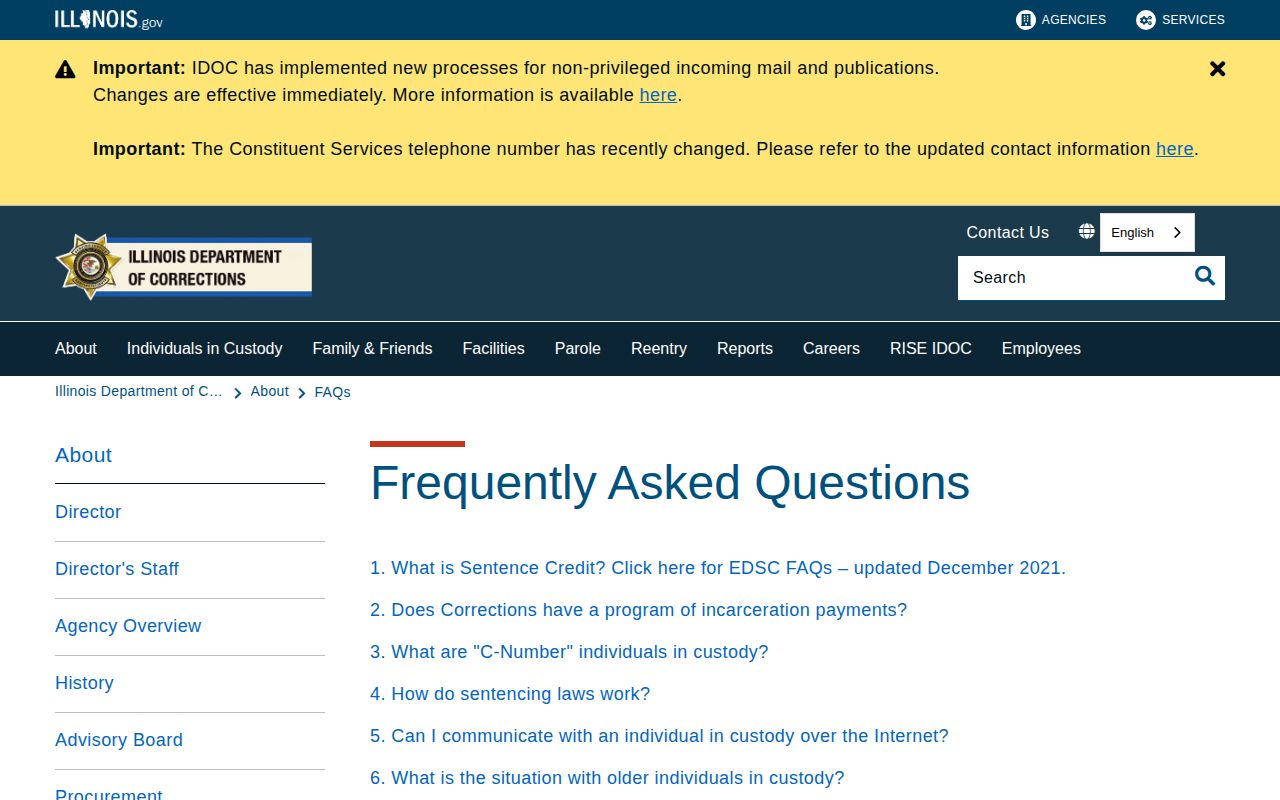
Reopen the live profile after any known recalculation and record the day of the check.
IDOC's docket and release-card directive says facilities keep calculation data, prepare release lists at least every 30 days, and update them when dates change. That internal schedule does not mean a public profile is a fixed monthly promise. It shows why a calculation can be revised as new credit or legal data reaches the file.
Presentence custody credit can also be corrected. Multiple sentences may be concurrent, meaning they run together, or consecutive, meaning one follows another. A corrected mittimus, which is the court's commitment order, may alter how IDOC computes the term. Resentencing and appellate action can do the same. The live agency record should be checked after each such event.
Federal Release Dates Near Peoria
A federal sentence uses the Bureau of Prisons locator and federal judgment, not Illinois credit percentages. A future BOP Release Date can change with federal calculations. “UNKNOWN” means the term has not been determined. A move to an RRC or home confinement remains BOP custody.
FCI Pekin is in neighboring Tazewell County and may hold people whose cases arose in Peoria. A BOP result of RELEASED means BOP custody ended, but state or immigration custody may follow. Read the judgment for supervised release and check any receiving authority.
The BOP locator can show Name, Register Number, age, race, sex, Release Date, and Location. A future date is projected. A past date with no facility location can mark the end of BOP custody, while IN TRANSIT is movement within the federal system. A Regional Office or RRM result can also reflect continuing custody outside a prison building.
Read Peoria IDOC Date Fields
The IDOC profile should be read as a set. IDOC number and identity fields confirm the match. Parent institution and Location show where the state assigns the person. Offender Status states the current category. Admission Date places the term in context. Parole Date, Projected Discharge Date, and “Sentence Discharged? YES/NO” then separate prison departure from the end of state control.
| IDOC field | What it means |
|---|---|
| Parole Date | Commonly marks prison-to-community supervision movement |
| Projected Discharge Date | Expected end of IDOC legal control |
| Offender Status | Current state category, including parole when shown |
| Location | Institution, transition center, or parole district |
| Sentence Discharged | Whether the sentence is recorded as discharged |
A person may disappear from the public IDOC search after discharge. No result is not enough to reconstruct the date. Use the court judgment, an earlier verified profile, and an IDOC records response as appropriate. A parole district means prison confinement ended, but supervision has not.
Peoria Release Holds and Transfers
A date calculation answers when one authority expects its term to change. It does not always answer where the person goes next. A county-to-IDOC transfer, federal handoff, immigration hold, or out-of-county warrant may keep the person in government custody after leaving the first facility.
Use affirmative evidence. A county transfer record should be followed in IDOC, BOP, ICE, or the named receiving county. An IDOC Parole status supports community supervision, while an Adult Transition Center location remains custody. For federal records, RELEASED ends BOP custody but does not rule out another sovereign. The receiving record completes the chain.
Release notifications can help mark a change but may omit the reason and exact official field. Save the date of the VINE check and corroborate it. Court orders explain legal authority, agency records show the custody movement, and supervision records show what continued afterward.
Peoria County juvenile matters require a different route. Adult jail, IDOC, BOP, and public mugshot tools are not substitutes for restricted juvenile records. A parent, guardian, lawyer, authorized custodian, or juvenile court is the proper source when public confirmation is unavailable. No adult sentence-credit estimate should be applied to a youth's detention status.
Keep a dated record of each official check. If the projected field moves, compare it with any new judgment, credit entry, or status change rather than assuming an error. If the date disappears, that alone does not prove discharge. The person may have transferred, the public profile may have changed, or access may be restricted after the sentence ended.
A reliable final note states both the event and the source. “IDOC profile showed PAROLE on the date checked” is more exact than saying the person was simply free. “Peoria County record showed transfer to IDOC” is more exact than saying the jail released the person. This phrasing keeps prison release, county discharge, transfer, and the end of supervision from being merged into one unsupported conclusion.
If a legal deadline depends on custody status, obtain the certified or direct agency record. A projected public field is useful for planning and notice, but it is not a substitute for the court order, computation record, or official discharge document.