
Peoria County Supervision Types
Illinois does not offer one public search for every person on parole or probation. A person leaving an Illinois Department of Corrections prison may enter parole or mandatory supervised release, often called MSR. IDOC field staff supervise that status, while the Illinois Prisoner Review Board sets conditions and handles revocation matters. Peoria County probation is different. It is imposed by the circuit court and administered by Peoria County Probation and Court Services. Someone sentenced to local probation may never have an IDOC profile.
| Record type | Who orders it | Best public check |
|---|---|---|
| Parole or MSR | IDOC and Prisoner Review Board framework | IDOC individual profile |
| Probation | Peoria County Circuit Court | Circuit Clerk docket and orders |
| Conditional discharge | Circuit court | Sentencing and later discharge orders |
The labels matter. Parole and MSR mean prison confinement ended but state legal control continues. Probation is a court sentence served in the community under local rules. Conditional discharge is a court-ordered status that may carry conditions without routine probation supervision. None of these terms, by itself, proves a current jail booking.
- Discharge
- The formal end of a sentence or supervision term.
- Absconder
- A person alleged to have stopped reporting or left supervision without approval.
- Revocation
- A process that may end community release and return a person to custody after required findings.
Check Peoria County Post-Release Status
Begin with the sentence, not a general name search. A Peoria County case can lead to local probation, an IDOC prison term, or another custody path. The court docket establishes the legal basis. The state profile then shows whether an IDOC sentence remains active after prison release.
- Search the Peoria County Circuit Clerk record by name and, when known, case number. Read the sentencing order and later entries.
- For an IDOC sentence, use the IDOC Individual in Custody Search. Match the IDOC number and identity details.
- Look for Offender Status PAROLE, a parole-district Location, a Parole Date, and a future Projected Discharge Date.
- For probation, rely on the filed Peoria County order. Ask the local office about record access without assuming private case details will be disclosed.
- After the expected end date, check for a discharge entry or updated IDOC field rather than treating an old projected date as final.
An IDOC profile showing parole means release from prison, not release from all legal control. By contrast, a current Peoria jail booking is a separate county custody event. If both appear, review the jail and court record alongside the state status.
Peoria County Probation Records
The public court file is the sound starting point for Peoria County probation. It may identify probation, conditional discharge, electronic monitoring, revocation, completion, or another later order. Day-to-day supervision facts can be restricted, so the office should not be expected to disclose a person's private reporting plan.
Peoria County Probation & Court Services324 Main Street, Room 520
Peoria, IL 61602
309-672-6018
Use the official Probation and Court Services directory to confirm current contact details. The Circuit Clerk docket is still the public source for the sentence and filed orders. A call can clarify office routing, but it does not replace an entered court record.
Peoria County Supervision Violations
Conditions may require reporting, approved travel, treatment, or compliance with court and board orders. An alleged violation is not the same as a final finding. For parole or MSR, the Prisoner Review Board distinguishes a preliminary hearing, which tests probable cause, from a final revocation hearing, which uses a preponderance of credible evidence. Records may show no violation, restored release, changed conditions, or revocation.
A new Peoria County Jail booking can exist at the same time as a state supervision case. Check both systems. Illinois VINE can send custody-event notices, but a notice does not explain the full supervision ruling. The IDOC profile and official board or court record supply the stronger status trail.
Peoria County Supervision Discharge
Supervision ends through an official discharge, not merely because a projected date passes. For IDOC cases, compare Parole Date, Projected Discharge Date, Offender Status, and the sentence field that asks whether the sentence is discharged. Credit recalculation, a board action, or a violation proceeding can change the path. The Peoria County released inmate search also explains how county, state, and court records fit together.
For probation, look for a filed completion or discharge entry in the Peoria County case. If the public case is later sealed or expunged, access may be restricted. That does not turn a stale copy into a current official record. Use the entered order and the lawful custodian's response.
Peoria County Parole Hearings
The Prisoner Review Board operations hub publishes a Monthly Board Calendar, while its revocation page posts current-month schedules and updated facility dockets. Hearings are currently described as video proceedings. Dates can change, and a place on a calendar does not mean release will be granted.
There is no public name-searchable instant decision database. Approved open-session and En Banc minutes form the public results trail, and they are posted after approval. Old-law indeterminate cases and qualifying youthful-review cases follow special statutes rather than the ordinary modern sentence path.
The official calendar page shows how Illinois organizes the hearing process.
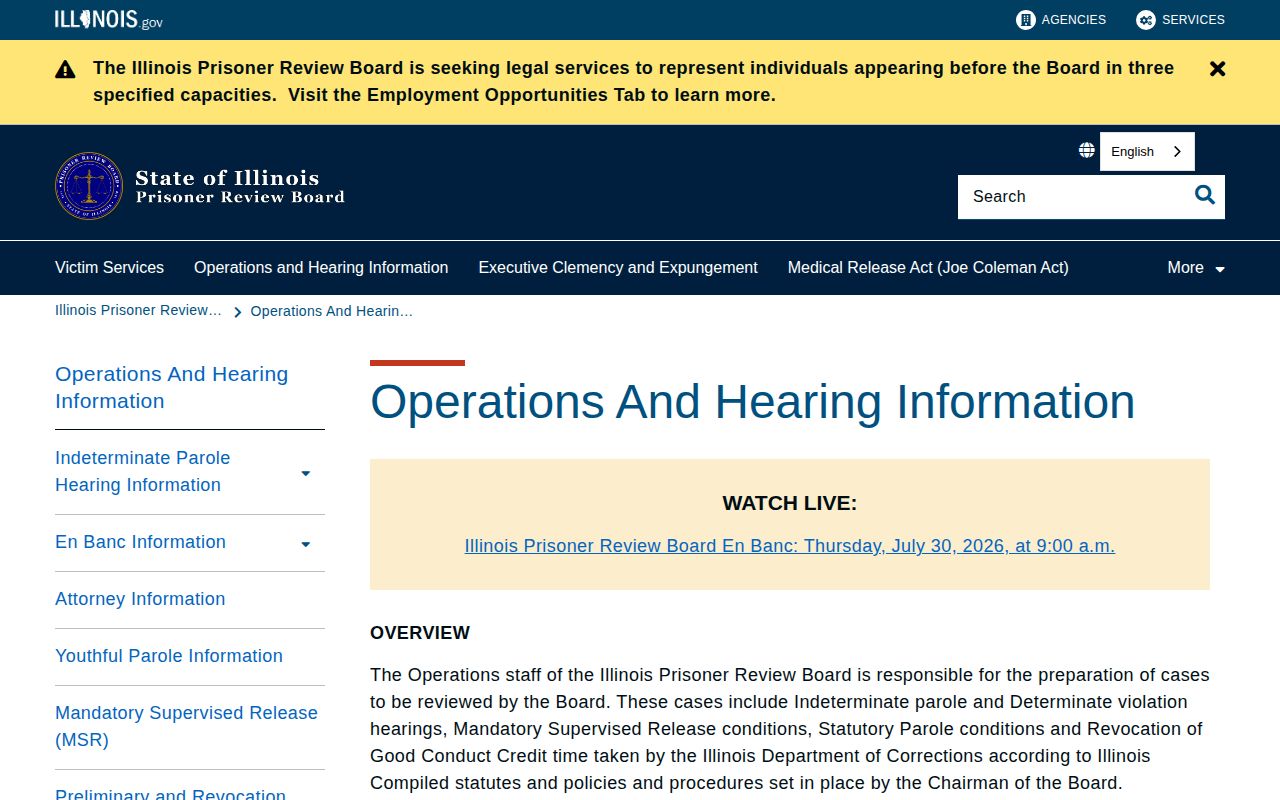
After a hearing, verify the result against IDOC status fields because the calendar alone reports no final custody outcome.
Proceeding type controls what the record can mean. En Banc parole minutes may reflect a grant, denial, or continuation to later review. Revocation records may show that no violation was found, that release was restored, that conditions changed, or that release was revoked. A preliminary hearing only tests whether probable cause exists. It is not the final ruling. These distinctions prevent a hearing date from being mistaken for a release date.
Old-law indeterminate parole generally concerns people sentenced for crimes committed before 1978, often tied to a “C” number. Board review follows the minimum term calculated by IDOC and may recur at intervals of one to five years under 730 ILCS 5/3-3-3. Youthful parole review is a separate route under 730 ILCS 5/5-4.5-115 for certain qualifying people who were under 21 at the time of the offense. Neither route applies to every Illinois prisoner.
Peoria Release or ATC Custody
Peoria's downtown Adult Transition Center creates a key status distinction. Residents may work, attend school, take approved leave, or receive independent release time, yet IDOC says transition-center residents remain in custody. Seeing someone in the community does not prove parole or discharge. Check the IDOC Location and Offender Status fields together.
A move from prison to the Peoria Adult Transition Center is a transfer within state custody. It is not the same as a Parole Date. The correct record should show when community supervision begins and when legal control is projected to end.
Peoria Jail Release to IDOC
The Peoria County Jail's property information says a detainee may sign property over to family or friends. It also uses the phrase “released to IDOC” when a sentenced person's cell items are made ready and a letter is sent. Here, released means the county handed custody to the state.
Follow that transfer in the IDOC search. Do not treat removal from the county roster as a return home. The receiving system, court mittimus, and county transfer time together show what happened.
Peoria Supervision Warrant Limits
The Peoria sheriff warrant database says it refreshes once every 24 hours, is incomplete, and may lag recent resolutions. A listed warrant does not prove a person is jailed. An absent name does not prove a supervision matter is closed.
Confirm warrant status with the Sheriff's Office at 301 North Maxwell Road or dispatch at 309-672-6011. IDOC also links a Wanted Fugitives channel, but that listing signals an agency interest, not a new conviction or final revocation. Never approach a person based on a database result.
The warrant database covers listed criminal misdemeanor and felony warrants, while other case types may not appear. Its stated daily refresh belongs only to that database. It must not be copied as the update schedule for jailing records, IDOC profiles, or court dockets. When a warrant and supervision status seem to conflict, note the time of each check and contact the agency named by the record.
A sheriff warrant is also not the same as an IDOC absconder or wanted-fugitive entry. The first is a county law-enforcement record. The second concerns a state corrections interest. A new court filing, jail booking, or Prisoner Review Board action may add the context needed to tell whether the person remains in the community, has returned to custody, or has completed supervision.
When the records disagree, preserve the IDOC number, Peoria case number, and the time each source was checked. Start with the newest official event, then trace backward to the sentence and release order. A VINE alert can flag movement, but it may not show the final supervision ruling. A court docket can show a warrant or revocation filing without proving that the person has been arrested. Agency confirmation closes that gap.
Supervision information should be used with care. Report only what the current official record states. Avoid labels that go beyond the record, and do not treat an allegation as a finding. If safety is a concern, contact law enforcement rather than trying to verify or confront the person in the community.